documenting important drivers in bitdefender EDR antigravity zone, and analysing how it catches bad guys
documenting important drivers in bitdefender EDR antigravity zone, and analysing how it catches bad guys
Inside Bitdefender’s Advanced Threat Control (atc.sys)
A technical deep-dive into a production EDR kernel sensor: bootstrap, authenticated IPC, behavioral classification pipeline, WFP networking, and process termination
Target: atc.sys, version v1.84.443.0 (build tag 0x00d8ca558) Symbol source: C:\docker_src\atc\bin\x64\Release\atc\atc.pdb Method: Static reverse engineering (IDA Pro, x64, flat virtual addresses) Intended audience: Security researchers, EDR/AV developers, kernel engineers, malware analysts, and threat-hunting teams
Reading guide and evidence model
This document is written for readers who already know what a minifilter is and what IRQL means. It still explains why the design choices matter, because that is where the real insight lives.
Before anything else, one methodological point, stated once and honored throughout:
A string or an import in a driver is evidence of intent, not proof of behavior.
When I write “ATC detects Heaven’s Gate,” the literal, verified claim is “the binary contains the string HeavenGate inside its detection logic.” Whether the technique is actually caught, how reliably, and under what conditions is a question that static analysis alone cannot answer. To keep the two apart, this document uses a strict vocabulary:
- Observed — present in the binary: a string, an import, a control-flow edge, a constant.
- Recovered — a control-flow structure (call tree, switch, loop) that we traced in IDA.
- Inferred / likely — an interpretation of observations based on how Windows works and how EDR products are built. These are labeled every time they appear.
Every address is a flat virtual address valid for this specific build (v1.84.443.0). Other builds of atc.sys will have different addresses.
Table of Contents
- What ATC is and what this document covers
- Build identity and what it leaks
- The module ecosystem around the driver
- Bootstrap and minifilter registration
- The IPC architecture 5.1. Why two ports? 5.2. The port name (and why it’s hidden) 5.3. Connection attestation — the handshake 5.4. The message dispatcher and command surface 5.5. The outbound path and
FltSendMessage - The behavioral detection pipeline 6.1. Event classification 6.2. The behavior switch 6.3. The suspicion engine 6.4. Verdict and action model
- Process termination
- Detection surface 8.1. Process, thread, and image monitoring 8.2. Anti-evasion heuristics 8.3. Interpreter hooking (Python, .NET, AMSI) 8.4. WFP network sensor and in-kernel HTTP parsing 8.5. Credential and logon telemetry 8.6. Detection categories
- Tamper defense
- Telemetry and event serialization
- Synthesis — how the pieces fit
- Open questions and next steps
- Appendices A. Key global symbols B. Observed strings (raw evidence) C. Key imports D. Glossary
1. What ATC is and what this document covers
Advanced Threat Control (ATC) is Bitdefender’s behavioral detection engine. Classic signature AV compares file hashes and byte patterns against a database of known malware. ATC takes a different path: it watches what software does — creating processes, mapping images, writing to other processes, connecting to the network, executing scripts — and judges whether the behavior looks malicious. This is what lets behavioral engines catch zero-days and heavily obfuscated families that no signature has been written for yet.
atc.sys is the kernel-resident half of that engine. It is the sensor that sits closest to the operating system and sees events the moment they happen.
What this document reconstructs, from static analysis:
- How the driver registers with the OS and what event surface it subscribes to.
- How it communicates with its user-mode partner — two Filter Manager communication ports, a cryptographic handshake, per-session cookies, and a serialized command dispatcher.
- How the detection pipeline is structured: classify → route → score → validate → act.
- How termination is executed in kernel mode.
- The breadth of its sensors: process/thread/image monitoring, an anti-evasion catalog, an interpreter hooking layer, a full WFP network sensor with an in-kernel HTTP parser, credential and logon telemetry, and anti-tamper machinery.
2. Build identity and what it leaks
The binary identifies itself clearly:
1
2
Version string :  v1.84.443.0 0x00d8ca558
PDB path       :  C:\docker_src\atc\bin\x64\Release\atc\atc.pdb
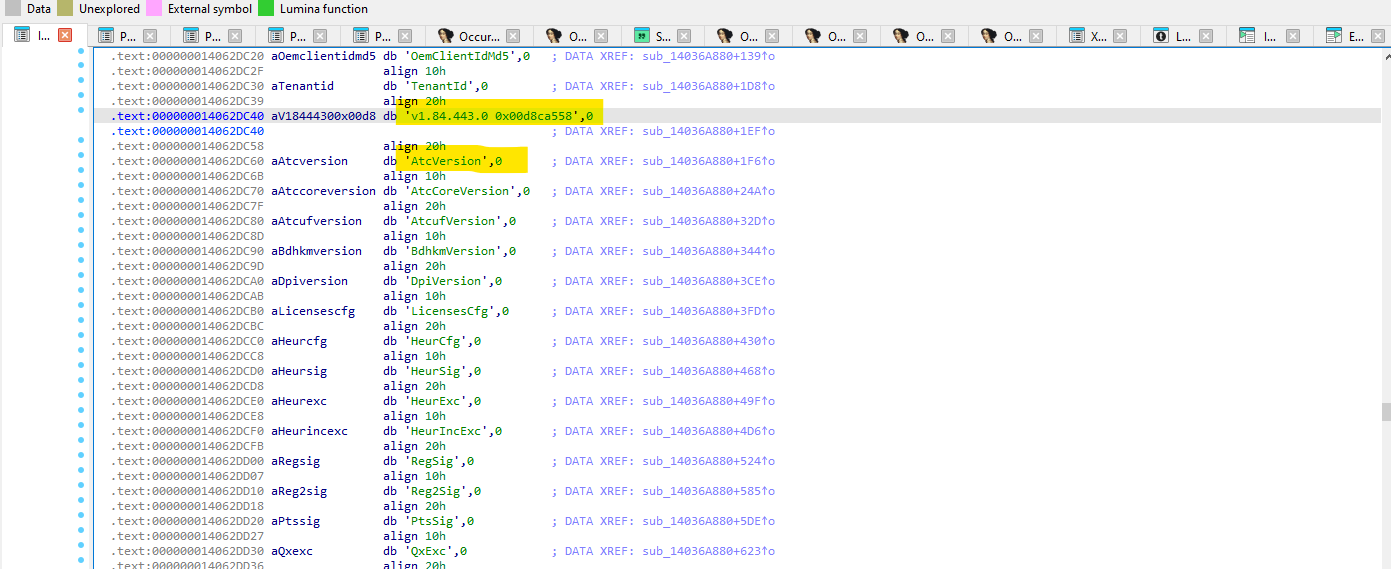
Three separate facts come out of these two lines, each worth understanding:
Version scheme.
1.84.443.0is the semantic version.0x00d8ca558is a build identifier embedded alongside it. Together they let you fingerprint the exact build — useful if you ever need to compare driver behavior across product updates.Build topology leak. The PDB path is
C:\docker_src\atc\bin\x64\Release\atc\atc.pdb. That tells us the build was produced in a Docker-based build environment (docker_src), in anx64 Releaseconfiguration, from a source tree with a top-levelatcdirectory. The PDB was not stripped before shipping. For analysis, an unstripped PDB is gold: if it were published, you’d have full symbol names. We only have the path, so we work from the binary’s flat names instead.A private section:
.atcsec. The binary contains a custom section named.atcsec. Custom sections are a deliberate layout choice. Common reasons: isolating self-protection/validation code so it occupies a dedicated mapped region, or preparing a contiguous region that something else (e.g., a loader or an integrity check) expects. Exactly what.atcsecprotects is not resolved in this pass, but its presence is a fact worth recording — it is part of how the driver takes care of its own integrity.
3. The module ecosystem around the driver
The version descriptor block references sibling components the driver coordinates with:
| Module | Reading of the name |
|---|---|
atcuf32.dll / atcuf64.dll | “ATC user-mode frontend” — the local user-mode client |
bdhkm32.dll / bdhkm64.dll | “Bitdefender kernel-memory/hook” — a hooking component |
AtcCoreVersion, AtcufVersion, BdhkmVersion, DpiVersion | Version bookkeeping |
The naming is informative:
atcuf— the user-mode frontend — is the process-side half of the ATC sensor. Everything the kernel reports is handed to this component.bdhkm— the kernel-memory/hook component — is what the “bitdefender kernel-mode” ecosystem injects to observe and sometimes hook process memory and API behavior.DpiVersion— “deep packet inspection” — corroborates the WFP/network portion of the driver we describe in §8.4.
A practical consequence for live analysis: the process that loads atcuf64.dll is the process that owns the ATC communication port. If you want to observe ATC IPC traffic in real time, that is the process to instrument.
4. Bootstrap and minifilter registration
4.1 The entry path
1
2
3
4
5
6
DriverEntry
   -> sub_1405F5540        ; driver-scope state construction
      -> sub_1405EECE0     ; filter instance creation
         -> FltRegisterFilter
              registration struct at 0x1407C2870
              filter GUID {045D888A-EB1C-11C9-9FE8-08002B104860}

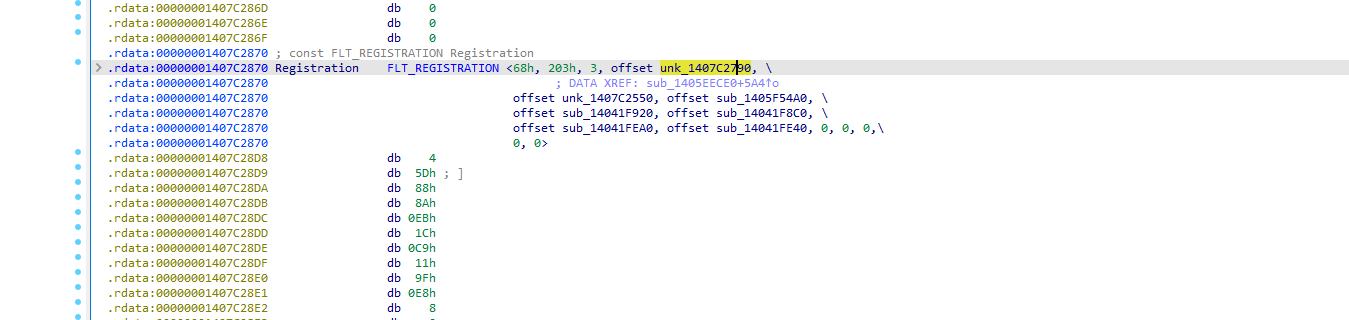
DriverEntry hands off quickly. sub_1405F5540 builds driver-level state (globals, locks, worker objects). sub_1405EECE0 constructs the filter instance and calls FltRegisterFilter with a registration structure at 0x1407C2870 — the structure that enumerates every callback the driver installs.
The filter has a stable GUID: {045D888A-EB1C-11C9-9FE8-08002B104860}. GUIDs in minifilter registration are the product’s permanent fingerprint. You can confirm a live instance with:
1
2
fltmc instances -v        ; lists minifilter instances and their altitude
!fltkd.filters            ; from the kernel debugger
4.2 What registration means, technically
Registering as a minifilter means the driver plugs into the Filter Manager’s I/O model. The Filter Manager interposes the driver between the I/O manager and the file system stack, invoking the driver’s callbacks (PreOperation, PostOperation, and port callbacks) on I/O that matches the driver’s registered operation set.
Two implications matter for an ATC-class driver:
- Altitude/ordering. Minifilters run in a defined order. A behavioral engine wants to see I/O early in the pipeline so it can both observe and, if needed, veto operations before they reach the file system.
- IRQL and context. Minifilter callbacks run at
APC_LEVELor lower for pre/post operations. This constrains what the callbacks can do — which is exactly why the kill path is deferred to a worker thread (see §7). Heavy work cannot happen inline in a callback.
Because ATC’s signal is behavioral, the driver leans on broad pre-operation coverage and routes everything into a heuristic pipeline rather than doing inline byte-pattern matching on buffers. That architectural choice — “collect and judge” instead of “match and drop” — is visible throughout the code.
5. The IPC architecture
5.1 Why two ports?
atc.sys publishes two Filter Manager communication ports:
| Port | Registration site | Role (observed) |
|---|---|---|
| Port A | sub_14032AB00 | Control / notification plane |
| Port B | sub_140227DE0 | Primary control channel |
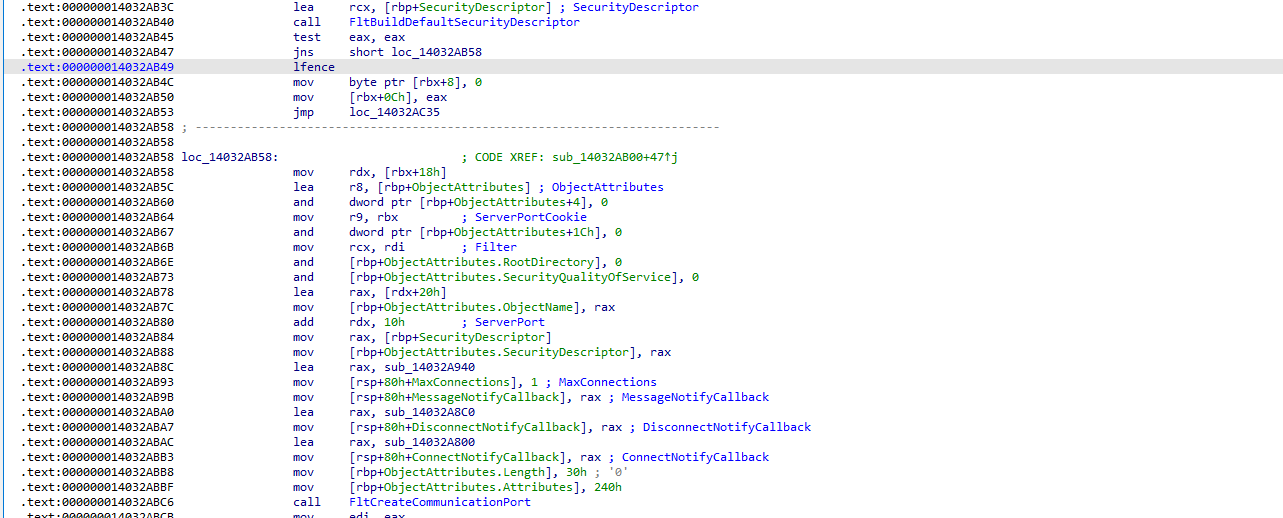
Both are created with MaxConnections = 1, so each accepts a single connected client. Splitting control into two ports is a common EDR pattern:
- One channel carries notifications (events flowing kernel → user mode).
- The other carries control (configuration, queries, commands flowing user → kernel).
Splitting them lets the driver serve high-frequency telemetry and low-frequency control without one blocking the other, and gives the driver two independent backchannels with independent state.
A security descriptor is built via FltBuildDefaultSecurityDescriptor, so the port is protected at the object level. But — and this is the important part — the descriptor is not the real gate. The driver runs its own attestation at connection time (§5.3).
5.2 The port name (and why it’s hidden)
Normally a driver exposes its communication port path as a static wide string, e.g. \Bitdefender\AtcPort. Here the port name is assembled at runtime into a data buffer (byte_1408B42C0) rather than baked into .rdata.

Why does this matter? Because the port path is the handle that lets user-mode processes find the driver. A runtime-built name means:
- a plain
stringspass over the driver reveals no port path; - the name may be derived from version data, a random seed, or machine state — which would make it differ per install or per boot.
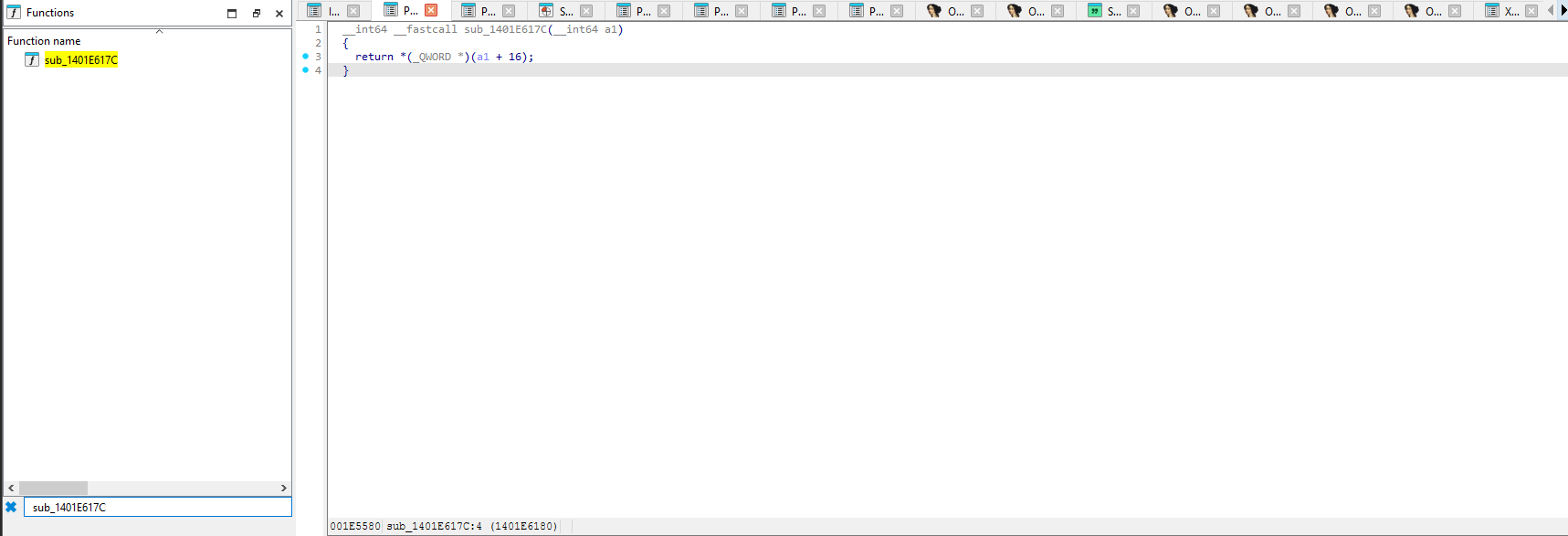
We investigated one promising builder, sub_1401E617C, and it turned out to be a trivial accessor — mov rax, [rcx+10h]; retn — i.e. a C++ field getter, not the name constructor. The real builder is still unlocated. This is recorded honestly in §12 rather than papered over.
5.3 Connection attestation — the handshake
1
2
3
4
5
6
7
8
9
10
11
12
13
14
15
16
17
18
19
20
21
22
23
24
25
26
27
28
29
30
31
32
33
34
35
36
37
38
39
40
41
42
43
44
45
46
47
48
49
50
51
52
53
54
55
56
57
58
59
60
61
62
63
64
65
66
67
68
69
70
71
72
73
74
75
76
77
78
79
80
81
82
83
84
85
86
87
88
89
90
91
92
93
94
95
96
97
98
99
100
101
102
103
104
105
106
107
108
109
110
111
112
113
114
115
116
117
118
119
120
121
122
123
124
125
126
127
128
129
130
131
132
133
134
135
136
137
138
139
140
141
142
143
144
145
146
147
148
149
150
151
152
153
154
155
156
157
158
159
160
161
162
163
164
165
166
167
168
169
170
171
172
173
174
175
176
177
178
179
180
181
182
183
184
185
186
187
188
189
190
191
192
193
194
195
196
197
198
199
200
201
202
203
204
205
206
207
208
209
210
211
212
213
214
215
216
217
218
219
220
221
222
223
224
225
226
227
228
229
230
231
232
233
234
235
236
237
238
239
240
241
242
243
244
245
246
247
248
249
250
251
252
253
254
255
256
257
258
259
260
261
262
263
264
265
266
267
268
269
270
271
272
273
274
275
276
277
278
279
280
281
282
283
284
285
286
287
288
289
290
291
292
293
294
295
__int64 __fastcall ConnectNotifyCallback(
        PFLT_PORT ClientPort,
        PVOID ServerPortCookie,
        unsigned __int16 *ConnectionContext,
        ULONG SizeOfContext,
        PVOID *ConnectionPortCookie)
{
  __int64 v5; // rdi
  PVOID *v8; // rdx
  __int64 result; // rax
  PDEVICE_OBJECT v10; // rcx
  __int64 v11; // rdx
  __int64 v12; // r9
  int v13; // edi
  int v14; // r9d
  __int64 i; // rdx
  int v16; // eax
  __int64 v17; // rdx
  NTSTATUS v18; // eax
  void *v19; // rax
  struct _TIME_FIELDS *v20; // [rsp+20h] [rbp-148h]
  unsigned int v21; // [rsp+50h] [rbp-118h]
  int v22; // [rsp+50h] [rbp-118h]
  __int128 v24; // [rsp+70h] [rbp-F8h]
  __int128 v25; // [rsp+80h] [rbp-E8h] BYREF
  __int64 v26; // [rsp+90h] [rbp-D8h] BYREF
  __int64 v27; // [rsp+98h] [rbp-D0h] BYREF
  __int128 v28; // [rsp+A0h] [rbp-C8h] BYREF
  _BYTE v29[16]; // [rsp+B0h] [rbp-B8h] BYREF
  _BYTE v30[112]; // [rsp+C0h] [rbp-A8h] BYREF
  _QWORD v31[2]; // [rsp+130h] [rbp-38h] BYREF

  v5 = SizeOfContext;
  v8 = ConnectionPortCookie;
  v27 = 0;
  v28 = 0;
  v26 = 0;
  *(_OWORD *)v31 = 0;
  if ( DeviceObject != (PDEVICE_OBJECT)&DeviceObject
    && (HIDWORD(DeviceObject->Timer) & 0x40) != 0
    && BYTE1(DeviceObject->Timer) >= 5u )
  {
    sub_140034D40(a1: DeviceObject->AttachedDevice, a2: 92, a3: &unk_1407AF870, a4: ClientPort);
    v8 = ConnectionPortCookie;
  }
  if ( ClientPort == nullptr )
  {
    if ( DeviceObject != (PDEVICE_OBJECT)&DeviceObject
      && (HIDWORD(DeviceObject->Timer) & 0x40) != 0
      && BYTE1(DeviceObject->Timer) >= 2u )
    {
      sub_14002AD40(a1: DeviceObject->AttachedDevice, a2: 93, a3: &unk_1407AF870, a4: 3221225711LL);
    }
    return 3221225711LL;
  }
  if ( ConnectionContext == nullptr || (unsigned int)v5 < 0x30 )
  {
    v10 = DeviceObject;
    if ( DeviceObject == (PDEVICE_OBJECT)&DeviceObject
      || (HIDWORD(DeviceObject->Timer) & 0x40) == 0
      || BYTE1(DeviceObject->Timer) < 2u )
    {
      return 3221225506LL;
    }
    v11 = 94;
LABEL_96:
    v12 = 3221225713LL;
LABEL_97:
    sub_14002AD40(a1: v10->AttachedDevice, a2: v11, a3: &unk_1407AF870, a4: v12);
    return 3221225506LL;
  }
  *((_DWORD *)ConnectionContext + 6) = -1073741823;
  if ( v5 - 48 < (unsigned __int64)ConnectionContext[22] )
  {
    v10 = DeviceObject;
    if ( DeviceObject == (PDEVICE_OBJECT)&DeviceObject
      || (HIDWORD(DeviceObject->Timer) & 0x40) == 0
      || BYTE1(DeviceObject->Timer) < 2u )
    {
      return 3221225506LL;
    }
    v11 = 95;
    goto LABEL_96;
  }
  if ( v8 == nullptr )
  {
    v10 = DeviceObject;
    if ( DeviceObject == (PDEVICE_OBJECT)&DeviceObject
      || (HIDWORD(DeviceObject->Timer) & 0x40) == 0
      || BYTE1(DeviceObject->Timer) < 2u )
    {
      return 3221225506LL;
    }
    v11 = 96;
    v12 = 3221225715LL;
    goto LABEL_97;
  }
  FltAcquirePushLockExclusive(PushLock: &qword_1408B4320);
  if ( byte_1408B4328 == 0 )
  {
    v13 = -402391036;
    goto LABEL_25;
  }
  if ( (unsigned __int8)sub_14002E454(a1: ConnectionContext) == 0 )
  {
    v13 = -402391032;
    v21 = -402391032;
    if ( DeviceObject != (PDEVICE_OBJECT)&DeviceObject
      && (HIDWORD(DeviceObject->Timer) & 0x40) != 0
      && BYTE1(DeviceObject->Timer) != 0 )
    {
      sub_140234A1C(
        a1: DeviceObject->AttachedDevice,
        a2: 97,
        a3: &unk_1407AF870,
        a4: 0,
        a5: 83,
        a6: 0,
        a7: *(_DWORD *)ConnectionContext,
        a8: *((_DWORD *)ConnectionContext + 1),
        a9: *((_DWORD *)ConnectionContext + 2));
    }
    goto LABEL_55;
  }
  LODWORD(stru_1408B1D20.Dpc.DeferredContext) = *((_DWORD *)ConnectionContext + 2);
  stru_1408B1D20.Dpc.DeferredRoutine = *(PKDEFERRED_ROUTINE *)ConnectionContext;
  stru_1408B1D20.Dpc.SystemArgument1 = *((PVOID *)ConnectionContext + 2);
  WORD1(v28) = ConnectionContext[22];
  LOWORD(v28) = WORD1(v28);
  *((_QWORD *)&v28 + 1) = ConnectionContext + 23;
  if ( (int)sub_1402419A0(a1: &qword_1408B3AA0, a2: 1, a3: &v28) >= 0 )
  {
    v13 = sub_14023E340(a1: &qword_1408B3AA0);
    v21 = v13;
    if ( v13 < 0 )
      goto LABEL_55;
    v13 = sub_140240500(a1: &qword_1408B3AA0, a2: &v27);
    v21 = v13;
    if ( v13 < 0 )
      goto LABEL_55;
    sub_14060A4E4(a1: v30);
    sub_14060A520(a1: v30, a2: ConnectionContext + 14, a3: 16);
    sub_14060A3C0(a1: v30);
    for ( i = 0; (unsigned int)i < 0x10; i = (unsigned int)(i + 1) )
      *((_BYTE *)v31 + i) = v30[i + 88];
    memset(v30, 0, 0x68u);
    v13 = sub_14044F1E0(a1: (int)v31, a2: v27, a3: (int)&v26, a4: v14, TimeFields: v20);
    v21 = v13;
    if ( v13 < 0 )
      goto LABEL_55;
    v16 = sub_1404638E0(a1: v26);
    v13 = v16;
    v21 = v16;
    if ( v16 < 0 )
    {
      if ( DeviceObject != (PDEVICE_OBJECT)&DeviceObject
        && (HIDWORD(DeviceObject->Timer) & 1) != 0
        && BYTE1(DeviceObject->Timer) >= 2u )
      {
        _mm_lfence();
        v13 = v16;
        sub_14002AD40(a1: DeviceObject->AttachedDevice, a2: 98, a3: &unk_1407AF870, a4: (unsigned int)v16);
      }
      goto LABEL_55;
    }
    sub_14046377C(a1: v26);
    v22 = sub_14037C5C0(a1: &unk_1408B42B0);
    if ( v22 < 0
      && DeviceObject != (PDEVICE_OBJECT)&DeviceObject
      && (HIDWORD(DeviceObject->Timer) & 0x40) != 0
      && BYTE1(DeviceObject->Timer) != 0 )
    {
      _mm_lfence();
      sub_14002AD40(a1: DeviceObject->AttachedDevice, a2: 99, a3: &unk_1407AF870, a4: (unsigned int)v22);
    }
    v29[0] = 0;
    sub_140490960(a1: v26, a2: v29);
    sub_140239E60(a1: &qword_1408B5A78, a2: v26, a3: v29);
    xmmword_1408B3C78 = *(_OWORD *)v31;
    if ( DeviceObject != (PDEVICE_OBJECT)&DeviceObject
      && (HIDWORD(DeviceObject->Timer) & 0x40) != 0
      && BYTE1(DeviceObject->Timer) >= 4u )
    {
      *((_QWORD *)&v24 + 1) = 16;
      *(_QWORD *)&v24 = v31;
      v25 = v24;
      sub_1401477A0(a1: DeviceObject->AttachedDevice, a2: 100, a3: &unk_1407AF870, a4: &v25);
    }
    LOBYTE(v17) = 1;
    sub_14025ACC0(a1: &unk_1408B5A80, a2: v17);
    sub_14025A900();
    sub_1401736A0(a1: &qword_1408B6078);
    v13 = 0;
  }
  else
  {
    v13 = -402390974;
  }
  v21 = v13;
LABEL_55:
  if ( v13 < 0 )
    goto LABEL_68;
  if ( ::ClientPort != nullptr )
  {
    v13 = -402391037;
  }
  else
  {
    qword_1408B4338 = (__int64)PsGetCurrentProcessId();
    v18 = PsLookupProcessByProcessId(ProcessId: (HANDLE)qword_1408B4338, Process: &Process);
    v13 = v18;
    v21 = v18;
    if ( v18 < 0 )
    {
      if ( DeviceObject != (PDEVICE_OBJECT)&DeviceObject
        && (HIDWORD(DeviceObject->Timer) & 0x40) != 0
        && BYTE1(DeviceObject->Timer) >= 2u )
      {
        _mm_lfence();
        v13 = v18;
        sub_14002AD40(a1: DeviceObject->AttachedDevice, a2: 101, a3: &unk_1407AF870, a4: (unsigned int)v18);
      }
      goto LABEL_68;
    }
    ::ClientPort = ClientPort;
    v19 = (void *)sub_14044F0E0(a1: ConnectionContext + 14);
    *ConnectionPortCookie = v19;
    qword_1408B3C98 = (__int64)v19;
    if ( DeviceObject != (PDEVICE_OBJECT)&DeviceObject
      && (HIDWORD(DeviceObject->Timer) & 0x40) != 0
      && BYTE1(DeviceObject->Timer) >= 4u )
    {
      sub_140234900(
        a1: DeviceObject->AttachedDevice,
        a2: 102,
        a3: (unsigned int)&unk_1407AF870,
        a4: qword_1408B4338,
        a5: qword_1408B4338,
        a6: (__int64)*ConnectionPortCookie);
    }
    _InterlockedExchange(&dword_1408B3C90, 1);
    v13 = 0;
  }
LABEL_25:
  v21 = v13;
LABEL_68:
  if ( v26 != 0 )
    sub_1404637A0(a1: &v26);
  if ( v27 != 0 )
    sub_140463840(a1: &v27);
  *((_DWORD *)ConnectionContext + 6) = v13;
  if ( v13 < 0 && Process != nullptr )
  {
    ObfDereferenceObject(Object: Process);
    Process = nullptr;
  }
  FltReleasePushLock(PushLock: &qword_1408B4320);
  if ( v13 >= 0 )
  {
    if ( DeviceObject != (PDEVICE_OBJECT)&DeviceObject
      && (HIDWORD(DeviceObject->Timer) & 0x40) != 0
      && BYTE1(DeviceObject->Timer) >= 4u )
    {
      _mm_lfence();
      sub_14002AD40(a1: DeviceObject->AttachedDevice, a2: 104, a3: &unk_1407AF870, a4: v21);
    }
    return 0;
  }
  else
  {
    if ( DeviceObject != (PDEVICE_OBJECT)&DeviceObject
      && (HIDWORD(DeviceObject->Timer) & 0x40) != 0
      && BYTE1(DeviceObject->Timer) >= 2u )
    {
      _mm_lfence();
      v13 = v21;
      sub_14002AD40(a1: DeviceObject->AttachedDevice, a2: 103, a3: &unk_1407AF870, a4: v21);
    }
    if ( v13 == -402390973 )
    {
      return 3221225730LL;
    }
    else if ( v13 == -402390964 )
    {
      return 3221225562LL;
    }
    else
    {
      result = 3221225875LL;
      if ( v13 != -402390963 )
        return 3221225506LL;
    }
  }
  return result;
}
When a user-mode client calls FilterConnectCommunicationPort, the Filter Manager invokes the driver’s ConnectNotifyCallback at sub_1402281C0. The recovered logic:
- Single-connection enforcement. A guarded flag ensures one live connection. A second concurrent connect is rejected with status
0xE8040004. - Context buffer requirements. The client must supply a connection context of at least
0x30bytes, containing the client name and attestation material. - Key check and cookie derivation.
- The client provides a 16-byte key inside the context.
- The driver hashes the key and compares it against a stored verification value.
- On success, the driver derives a per-connection cookie (session nonce) and stores it in
qword_1408B3C98.
- Identity recording. The connecting process’s PID and EPROCESS are stored (
qword_1408B4338andProcess). - Global state transition. The driver stores the connected
ClientPortpointer globally and atomically setsdword_1408B3C90to 1 under a shared push lock. A small accessor later reads::ClientPortordword_1408B3C90to answer ‘is the client up?’”
sub_140228154 is an atomic state query getter.
It reads the current value of the global flag dword_1408B3C90 in a thread-safe manner and returns whether that flag is set to 1.
How it works:
1
2
3
4
5
_InterlockedCompareExchange(&dword_1408B3C90, 1, 1) attempts to exchange the value with 1 only if it is already 1.

Since the exchange value and the comparand are identical, this operation never changes the variable—it simply reads the current value atomically and returns the original value.

The function then checks if that returned original value equals 1.
What it returns:
1
2
3
true → The driver has a valid, connected client (the handshake succeeded and the flag was set to 1 by the connection callback).

false → No valid client is currently connected.
Its role in the driver: This is a lightweight, thread-safe helper used by other parts of the driver (e.g., message dispatch routines, cleanup paths, or telemetry functions) to quickly poll or verify whether the user-mode client is alive and authenticated without needing to acquire a heavy lock or check multiple globals.
5.4 The message dispatcher and command surface
The hub is MessageNotifyCallback (sub_140228B00). On each received message it:
Validates the port cookie. It compares the
PortCookieparameter (supplied by the Filter Manager) against the stored session cookieqword_1408B3C98. This ensures the message originates from the authenticated client connection.Checks the client connection state. It atomically reads
dword_1408B3C90to confirm that a client is currently connected. This is a state query, not a lock acquisition.Verifies driver readiness. It calls
sub_1402280E0()(likely a helper that reads a separate initialization flag) to ensure the driver is fully operational before processing commands.Validates input parameters. It enforces a minimum input size of
4bytes, checks for null buffers, and ensures output buffers are consistent.Routes the command. It switches on the first DWORD (
*InputBuffer) of the message body. The decompiled code reveals a large dispatch tree that handles at least 47 distinct opcodes (ranging from0x00to0x2E, with gaps), including:0x00→sub_14022EAE00x01→sub_1402324200x02→sub_1402328800x03→sub_1402311000x04→sub_1402332C00x05→sub_14022D7800x06→sub_1402312A00x07→sub_14022CC800x08→sub_14022C5800x09→sub_14022D7000x0A→sub_14022D8E00x0B→sub_1402314000x0C→sub_140232AC0(with a flag)0x0D→sub_14022E0E00x0E→sub_14022EBC0- …and continues through
0x1A,0x27,0x2E, etc.
Unknown opcodes fall through to a default handler (
sub_14022ED40) which rejects the message.
This dispatcher is the ATC control surface: every configuration write, query, and policy change from user mode lands here. Mapping each handler’s semantics is outstanding work (§12).
5.5 The outbound path and FltSendMessage
Outbound notifications are centralized in sub_14032AC80, a wrapper over FltSendMessage that:
Applies a timeout. It reads
dword_1408B3B78(a DWORD timeout value) and converts it to a negative 100-nanosecond interval (-10000000 * value) to pass as a relative timeout toFltSendMessage.Conditionally caps message size. Only when the
a6flag is non-zero does the wrapper enforce a maximum message size of0xFFF0bytes (just under 64 KB). Ifa6is zero, the length check is skipped entirely and the buffer is passed through unchanged. When the cap is exceeded (anda6is set), the function bypassesFltSendMessageand routes to a fallback handler (sub_140424920), likely for error logging or size-rejection handling.Does NOT enforce connection state. Unlike the message dispatcher, this send wrapper performs no custom checks for
dword_1408B3C90,::ClientPort, or any other “client alive” flags. It relies purely on the Filter Manager’sFltSendMessageAPI to validate the port handle and handle disconnection gracefully.Handles timeouts explicitly. If
FltSendMessagereturns258(STATUS_TIMEOUT), the wrapper translates it to a custom driver error code (3892576326LL, or0xE8040006).
Centralizing the send path is defensive engineering: one place to enforce timeout, size (conditionally), and timeout handling means consistent behavior across the driver. The near-64 KB cap—when enabled—is a size guard, likely a deliberate anti-fragmentation / anti-DoS limit for kernel pools.
6. The behavioral detection pipeline
This is the heart of ATC. The recovered flow:
1
2
3
4
5
6
7
minifilter callbacks
   -> event classification        (three dispatch arms)
   -> behavior switch             sub_14037C960
   -> suspicion / heuristics      sub_14037E8C0
   -> verdict validator           sub_1404683A0
   -> action queue                piNoAction / piKillProcess / piSendActions ...
   -> (if kill) worker            unk_1408B4720
6.1 Event classification
Events arrive from the registered callbacks and are normalized by three pre-operation dispatch arms (0x140651DC0, 0x14064E830, 0x14065000) into internal event identifiers. The network path feeds in here too: decoded HTTP flows from the WFP sensor are mapped to the same event namespace, which is how file behavior and network behavior end up scoring the same process.
6.2 The behavior switch
sub_14037C960 switches on the classified event identifier and selects the appropriate heuristic evaluator. It is the router of the detector: it decides which checks run for a given event class, not whether something is malicious. Routing is intentionally separate from judging so that new event types can be added without reworking the scoring core.
6.3 The suspicion engine
sub_14037E8C0 is the scoring core. It accumulates suspicion for the process under watch and pulls evidence from multiple sources:
- its own heuristics database;
- module/”watchdog” results (suspicious loads, hook anomalies);
- interpreter hooks (Python/.NET, §8.3);
- network flow context from the WFP sensor (§8.4).
The important conceptual point: detection here is a scoring problem, not a boolean problem. Individual weak signals (a stack pivot here, a direct syscall there, a suspicious module load over there) are weighted and combined. No single signal necessarily trips a detection; the combination does. That is the behavioral philosophy made concrete, and it is why ATC can catch threats whose individual actions look innocuous.
6.4 Verdict and action model
sub_1404683A0 consolidates the signals into a verdict, expressed with an enum family visible in the binary:
piNoAction— do nothing;piKillProcess— terminate the subject process;piSendActions— forward a richer action set;IntegratorResponse/ShouldNotifyIntegrator— defer to the user-mode Integrator.
This is the kernel/user-mode policy boundary: the kernel proposes, the agent decides. The kernel computes verdicts and emits action tokens; the user-mode Integrator (the GravityZone/EDR agent) is notified and owns final remediation policy. The strings EDR Terminate and EDR Freeze tie this to the EDR product line’s remediation actions.
7. Process termination
When the verdict is piKillProcess, termination runs in an asynchronous worker, not inline in the callback:
1
2
3
4
5
6
verdict reached
   -> job enqueued into worker queue   unk_1408B4720
worker (sub_140497540)
   -> execute the job                  sub_140499A20
       -> open the target process
       -> ZwTerminateProcess(..., 0xC0000022)
Facts established:
ZwTerminateProcessis imported and called from exactly one site in the driver. There is no second, hidden kill path.- The exit status handed to the victim is
0xC0000022(STATUS_ACCESS_DENIED) — the value the terminating process observes as its exit code. - The worker queue (
unk_1408B4720) decouples deciding from doing. This matters at a technical level: killing a process from inside a minifilter callback would violate IRQL expectations and stall the initiating I/O. By deferring to a worker atPASSIVE_LEVEL, the driver keeps the pipeline responsive while termination proceeds in the background.
The net effect: ATC does not merely report a malicious process. The driver is physically capable of terminating it in kernel mode, at the appropriate IRQL, through a single audited code path.
8. Detection surface
This section is driven by the string table and the imported routine set. Where I say a string was observed, it is a fact; where I interpret its purpose, I say so.
8.1 Process, thread, and image monitoring
The driver consumes process/thread/load-image notifications and tracks:
- process creation and termination, including parent/child relationships;
- image loads, with attention to suspicious modules;
- “forked” processes and mutation via memory writes (
NtWriteVirtualMemory-style); - process hollowing — confirmed by the string
ProcessHollowing.
Process hollowing is a canonical EDR watch item: a legitimately-signed process is started, its image is overwritten in memory, and the attacker’s payload runs under a trusted identity. Catching that requires correlating image-map events with memory-write events — which is exactly the kind of cross-source correlation the pipeline in §6 is built for.
8.2 Anti-evasion heuristics
The binary names a large catalog of evasion techniques (all observed strings):
| String | Technique |
|---|---|
HeavenGate | “Heaven’s Gate”: crossing the 32/64-bit syscall boundary to dodge hooks |
DirectSyscall, Syscall | calling syscalls directly to bypass user-mode API hooks |
Rop, StackPivot, StackShell, StackSpoofing | stack/ROP-based obfuscation |
StolenToken | stealing a privileged process’s token |
ReflectiveDll | reflective DLL injection (self-mapping, no loader participation) |
ParentSpoofing | faking the parent process ID |
ModuleHook, ModuleStomp | hooking or overwriting module code |
Unexpected Syscall, Sig Scan, EPR shell | additional syscall/signature anomalies |
Why this matters conceptually: the presence of this catalog tells us ATC isn’t only watching what programs do — it watches for programs that appear to be trying to avoid being watched. That is the distinguishing trait of defense-aware malware, and detecting it is one of the hardest and most valuable things an EDR does.
8.3 Interpreter hooking (Python, .NET, AMSI)
The driver hooks interpreter and runtime entry points so it sees script execution, not just script bytes:
- Python:
PyEval_EvalCode,PyRun_StringFlags - .NET:
mscoree.dll,coreclr.dll,LdrLoadDll - AMSI: AMSI context fields
The reasoning is elegant: fileless malware often ships an obfuscated script that only becomes readable at runtime, when it is decrypted and about to be interpreted. If you hook the interpreter itself — PyEval_EvalCode, the CLR entry points — you see the payload at the exact moment of execution, already deobfuscated. This is how ATC catches scripts that would sail past on-disk scanners.
8.4 WFP network sensor and in-kernel HTTP parsing
This is a major finding: atc.sys is not just a file driver. It registers WFP (Windows Filtering Platform) callouts and inspects network traffic. Observed imports:
FwpsCopyStreamDataToBuffer0— copy reassembled stream data;FwpsFlowAssociateContext0— associate a network flow with driver context;FwpmFilterAdd0— add a WFP filter;- callout register/unregister functions (
fwpkclnt.sys).
On top of that plumbing sits an HTTP parser running inside the kernel:
ConsumeHttpRequestLine,ConsumeHttpHeaders,ConsumeHttpBody- HTTP fields such as
Host:,User-Agent:,Content-Encoding:,Allow: - flow-direction context (
FlowDirectionInfo) tracking connections per process
Observed network telemetry fields: ConnectionsCount, ConnectedIPs, RemoteUrl, DNSQueries, RemotePort, ListenInitialMovementRemoteIp.
What this means, technically: HTTP-level inspection — URLs, headers, and content attributes — is performed in kernel space, on reassembled flows, as part of the behavioral pipeline. That allows the driver to correlate a process’s network behavior with its local behavior without round-tripping packets to user mode. The DpiVersion string in the version block (§3) is the confirmation of intent: this is the DPI component of ATC.
8.5 Credential and logon telemetry
A focused field set relates to authentication (all observed):
TokenType,LUIDNtPasswordPresent,LmPasswordPresent,PasswordExpiredOriginalUserSid,ImpersonatedUserSidAreLmEqual,AreNtlmEqual,RaiseLogin
Careful reading. These strings exist. They suggest the driver observes logon/NTLM-related events — the kind of signal used to detect pass-the-hash, logon anomalies, and impersonation abuse. Whether every field is actively populated in every build is a question for dynamic testing; what is fact is that the field names are present in the binary’s data structures.
8.6 Detection categories
The engine classifies verdicts into named categories (observed strings):
1
detection, beta detection, prometheus, game detection, ml detection, rsp detection, cbe detection
detection/beta detection— stable and experimental heuristics;ml detection— machine-learning verdicts;game detection— gaming-mode / anti-cheat compatibility exceptions;rsp detection,cbe detection— likely remote-behavioral and cloud-behavioral sources (labeled as inference).
The coexistence of local heuristics, ML verdicts, and cloud-behavioral sources in one namespace is the modern EDR model: multiple detectors, one unified verdict feed.
9. Tamper defense
The driver takes an active interest in the OS’s internal callback arrays (observed strings):
PspCreateProcessNotifyRoutinePspCreateThreadNotifyRoutinePspLoadImageNotifyRoutineCallbackListHead
These are the kernel’s own lists of which drivers registered for process/thread/image notifications. A normal driver never touches them. An EDR driver reads — and sometimes patches — them, for two purposes:
- Situational awareness. Knowing who else registered tells the driver which other EDRs, anti-cheats, or rootkits are present, and whether any of them are hooking the same structures to hide from each other.
- Self-protection. Strings like
DualProtectedProcessTerminateandUmAntiTamperindicate the driver defends its own processes from being terminated or modified.
This is the signature of a hardened, productized EDR driver rather than a research prototype. Rootkits and “AV killers” abuse these same structures to hide processes and disable protections; an EDR that watches the watchers is doing its job.
10. Telemetry and event serialization
Events are serialized and shipped to the user-mode client (observed strings):
- framing:
JsonEvent,event_time,machineEntropy,machine_arch,host_name - orchestration:
TriggerHeuristicForProcess,TriggerEngineRequest - feedback:
FeedbackFile*,PrometheusFeedbackFile,DsSendAsyncRequestToCore
The picture: the driver builds structured (JSON-like) events, triggers heuristics per-process, and ships results upward. DsSendAsyncRequestToCore and the Integrator tokens are strong evidence that telemetry is relayed through the user-mode agent to Bitdefender’s core/cloud. There is no dashboard socket inside this driver. The cloud leg lives in user mode, behind the authenticated local port described in §5.
Two strings tie the loop: EDR Terminate and EDR Freeze. They confirm ATC is integrated with the EDR product line’s remediation actions — the agent doesn’t just get a report, it gets an actionable verdict it can act on.
11. Synthesis — how the pieces fit
Put together, atc.sys is:
- a minifilter with a stable GUID and broad pre-operation coverage (§4);
- two single-connection ports, guarded by a cryptographic handshake, per-session cookies, and single-flight serialization (§5);
- a staged behavioral pipeline: classify → route → score → validate → act (§6);
- an asynchronous kill worker with exactly one
ZwTerminateProcesscall site (§7); - a network sensor with in-kernel HTTP parsing (WFP) (§8.4), interpreter hooks for Python/.NET (§8.3), credential/logon telemetry (§8.5), and tamper defense over the OS callback arrays (§9);
- and, above all, a clean separation of powers: the kernel proposes, the agent decides (§6.4).
The design is coherent and deliberately layered: the kernel collects rich behavioral signal, the control channel is authenticated and serialized, and remediation policy lives in user mode where it can be updated without shipping a new driver.
12. Open questions and next steps
Static analysis has limits, stated plainly:
- The actual port name string. Runtime-assembled into
byte_1408B42C0;sub_1401E617Cis a getter, not the builder. Recovery options:- trace the
FltCreateCommunicationPortcall sites insub_1405EECE0/sub_140227DE0and dump theUNICODE_STRINGargument; - on a live system, read the name with
!fltkd.ports/fltmc ports.
- trace the
- Which process connects. We store the client PID/EPROCESS (
qword_1408B4338/Process), but confirming which process that is (the one hostingatcuf64.dll) needs a live system. - The full command table. The ~27 dispatch slots (0x00–0x1A) are confirmed; individual handler semantics are not yet mapped.
- Scoring internals.
sub_1404683A0may consult scoring state we could not fully reach statically. - WFP callout details. The callout GUIDs and exact filter conditions would tell us precisely which flows are inspected.
Appendix A — Key global symbols
| Symbol | Role |
|---|---|
byte_1408B42C0 | Runtime-assembled port-name buffer |
byte_1408B4328 | “Client connected” flag |
qword_1408B3C98 | Per-connection session cookie |
dword_1408B3C90 | Single-flight message guard |
dword_1408B3B78 | Outbound message timeout |
qword_1408B4338 | Connecting client PID |
Process | Connecting client EPROCESS |
unk_1408B4720 | Kill worker queue |
0x1407C2790 | Pre-op / pool table |
stru_1408B1D20 | Driver state container |
Appendix B — Observed strings (raw evidence)
Anti-evasion: HeavenGate, DirectSyscall, Syscall, Rop, StackPivot, StackShell, StackSpoofing, StolenToken, ReflectiveDll, ProcessHollowing, ParentSpoofing, ModuleHook, ModuleStomp, Unexpected Syscall, Sig Scan, EPR shell
Network: ConnectionsCount, ConnectedIPs, RemoteUrl, DNSQueries, RemotePort, ListenInitialMovementRemoteIp, FlowDirectionInfo
HTTP parser: ConsumeHttpRequestLine, ConsumeHttpHeaders, ConsumeHttpBody, Host:, User-Agent:, Content-Encoding:, Allow:
Credentials/logon: TokenType, LUID, NtPasswordPresent, LmPasswordPresent, PasswordExpired, OriginalUserSid, ImpersonatedUserSid, AreLmEqual, AreNtlmEqual, RaiseLogin
Scripting/.NET: PyEval_EvalCode, PyRun_StringFlags, mscoree.dll, coreclr.dll, LdrLoadDll, AmsiContext
Decisions/actions: piNoAction, piKillProcess, piSendActions, IntegratorResponse, ShouldNotifyIntegrator, EDR Terminate, EDR Freeze
Tamper defense: PspCreateProcessNotifyRoutine, PspCreateThreadNotifyRoutine, PspLoadImageNotifyRoutine, CallbackListHead, DualProtectedProcessTerminate, UmAntiTamper
Detection categories: detection, beta detection, prometheus, game detection, ml detection, rsp detection, cbe detection
Telemetry: JsonEvent, event_time, machineEntropy, machine_arch, host_name, TriggerHeuristicForProcess, TriggerEngineRequest, FeedbackFile*, PrometheusFeedbackFile, DsSendAsyncRequestToCore
Appendix C — Key imports
- Filter Manager:
FltRegisterFilter,FltCreateCommunicationPort,FltBuildDefaultSecurityDescriptor,FltSendMessage - Process / NT:
ZwTerminateProcess,ZwOpenProcess,ZwProtectVirtualMemory,ZwRead/WriteVirtualMemory,NtQueueApcThread - Callbacks: process/thread/load-image/registry/object notification registration
- WFP:
FwpsCopyStreamDataToBuffer0,FwpsFlowAssociateContext0,FwpmFilterAdd0 - Crypto:
BCryptVerifySignature*(CNG) — signature verification of modules/executables - AMSI / CLR / scripting: AMSI context primitives,
mscoree.dll,coreclr.dll - Security:
SeAccessCheck, security descriptor management
Appendix D — Glossary
- Minifilter — a kernel driver that plugs into the Filter Manager’s I/O pipeline.
- Filter altitude — the ordered position of a minifilter in the I/O stack.
- GUID — a unique identifier; here, the filter’s permanent fingerprint.
- IPC — inter-process communication; message exchange between a driver and user-mode code.
- WFP — Windows Filtering Platform, the kernel framework for inspecting/altering network traffic.
- Attestation — proving possession of a secret before being trusted.
- Cookie — a session token; proves a message belongs to an authenticated session.
- IRQL / PASSIVE_LEVEL / APC_LEVEL — Windows interrupt priority levels; heavy work like killing a process must run at the lowest one.
- Heuristics — rules based on behavior rather than exact known-malware fingerprints.
- Reflective DLL injection — loading a DLL entirely in memory, without the OS loader.
Disclaimer
This document is a defensive, static reverse-engineering exercise on a commercially licensed EDR driver. It describes observable interfaces and recovered architecture for the purpose of understanding how kernel-mode endpoint protection works. It describes no security vulnerability, and no vulnerability claim is made. All addresses are flat virtual addresses from the specific build analyzed (v1.84.443.0) and will differ on other builds. Items labeled “likely” or “inferred” are interpretations of observed strings/imports and should be validated dynamically before being relied upon. Strings in a driver are evidence of intent, not proof of behavior. this is just static analysis so some sections may be wrong so please feel free to tell me
Inside Bitdefender’s Trufos Real-Time Protection Driver (trufos.sys)
A technical deep-dive into a production kernel sensor: bootstrap, authenticated IPC, the 27-command surface, image validation, registry blocking, raw-NTFS directory accounting, and token-handle operations
Target: trufos.sys Symbol source: C:\trufos\bin\x64\ReleaseKernel\trufos.pdb Build metadata: compiled Jun 25 2026, identifier c86a5d46 Method: Static reverse engineering (IDA Pro, x64, flat virtual addresses) Intended audience: Security researchers, EDR/AV developers, kernel engineers, malware analysts, and threat-hunting teams
Reading guide and evidence model
This document is written for readers who already know what a minifilter is and what IRQL means. It still explains why the design choices matter, because that is where the real insight lives.
Before anything else, one methodological point, stated once and honored throughout:
A string or an import in a driver is evidence of intent, not proof of behavior.
To keep the two apart, this document uses a strict vocabulary:
- Observed — present in the binary: a string, an import, a control-flow edge, a constant.
- Recovered — a control-flow structure (call tree, switch, loop) that we traced in IDA.
- Inferred / likely — an interpretation of observations based on how Windows works and how EDR products are built. These are labeled every time they appear.
Every address is a flat virtual address valid for this specific build. Other builds will have different addresses.
Table of Contents
- What
trufos.sysis and what this document covers - Build identity and what it leaks
- Bootstrap and initialization
- The IPC architecture 4.1. The communication port 4.2. Connection access control and the version handshake 4.3. The message dispatcher and the 27-command surface
- Subsystem: asynchronous image validation (
TrfBlockImage, command 4) - Subsystem: registry tamper blocking (
regblock, command 12) - Subsystem: raw-NTFS directory counting (
rawdircnt, command 16) - Subsystem: token-handle operations (command 22)
- Self-protection and reliability measures
- Synthesis — how the pieces fit
- Open questions and next steps
- Appendices A. Key global symbols B. Observed strings (raw evidence) C. Observed source paths D. Key imports E. Command dispatch table F. Glossary
1. What trufos.sys is and what this document covers
trufos.sys is a kernel-resident real-time protection driver in the Bitdefender ecosystem. Where atc.sys (the Advanced Threat Control engine) scores behavior, trufos.sys provides the on-access, on-demand protection primitives that sit close to the operating system: deciding what images are allowed, blocking registry tampering, counting directory contents at the file-system level, and performing process/token operations. In modern Bitdefender deployments the two drivers complement one another.
What this document reconstructs, from static analysis:
- How the driver registers and reads its configuration (
drvinit.c,context.c,prfmiddle.c). - How it publishes exactly one communication port and how access to it is gated.
- The full message-dispatcher command surface (27 handlers) and the four we traced in depth.
- The self-protection and reliability measures baked into the design.
2. Build identity and what it leaks
The binary identifies itself clearly through its PDB path and build metadata:
1
2
3
PDB path   :  C:\trufos\bin\x64\ReleaseKernel\trufos.pdb
Build date :  Jun 25 2026
Hash       :  c86a5d46
Three facts come out of these lines:
- Release configuration.
x64\ReleaseKerneltells us this is a 64-bit kernel driver built in a Release configuration (optimizations enabled, but PDB symbols kept for internal trace paths). - Source tree layout. The PDB root is
C:\trufos\, with a top-leveltrufosdirectory. The source paths embedded in the binary (Appendix C) map the product’s internal division of labor. - Private file-name evidence. The referenced sources name the driver’s own components: registry blocking (
regblock.c), raw directory counting (rawdircnt.c), user-mode library communication (umlibcomm.c/umlibcommands.c), driver init (drvinit.c), context management (cage), and a performance-mid layer (prfmiddle.c). The IPC plumbing lives under a dedicatedpetrulibfolder. These are internal names and they leak design intent.
3. Bootstrap and initialization
Recovered initialization facts:
- Safe-mode block. The driver refuses to load in Windows Safe Mode, returning
STATUS_DRIVER_BLOCKED. Safe mode is where self-healing and repair tooling runs; a protection driver that cannot trust the environment refuses rather than risk being partially effective. - Driver context. A single per-driver context of 0x7D0 bytes, pool-tagged
'TRF:'(0x53465254as the dword tag), constructed fromstru_1400925E0. - Locking. Two dedicated locks: an
UnloadLockat context+0x150and aRegistryBlockLockat context+0x688used by theregblocksubsystem. - Configuration from the registry. The driver verifies a configuration path (the
a2argument to its init path), locates components from the registry, and keeps post-reboot tracking viaAfterRebootComandsListandAfterRebootResultsComandList— a mechanism for deferring actions until a later boot. - Enablement state machine. A “BDM” (boot/decision manager) state machine controls the effective operating state through
BdmInitData,BdmEvaluateState, andBdmSetAndSaveState. This is the switch that lets the product enable or disable the driver’s protections around a specific state. - Dynamic syscall resolution. Rather than relying solely on imported NT routines, the driver resolves calls dynamically — an anti-patching / self-reliance measure (§9).
- Device-object state checks. Many paths begin with a guard on the global
DeviceObject, checking its state before dereferencing and frequently preceded bylfence— the release-build reliability scaffolding.
4. The IPC architecture
4.1 The communication port
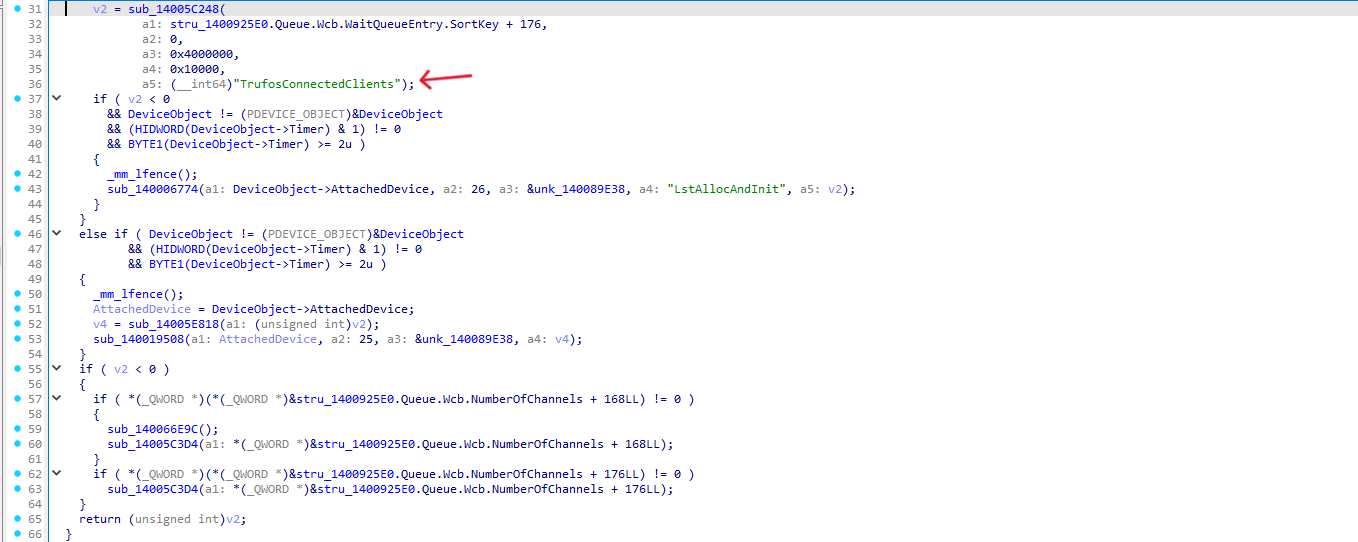
trufos.sys publishes one communication channel. Despite the user-mode library references (umlibcomm.c, umlibcommands.c), the low-level transport is a single Filter Manager port:
| Fact | Value |
|---|---|
| Port object name | TRFCOMMPORT |
| Server filename | trufosportserver |
| Client-list symbol | TrufosConnectedClients |
| Peak connections | 1 (MaxConnections = 1) |
| Connect callback | sub_1400405E0 (version handshake) |
| Message / broadcast | sub_14003F890 |
| Dispatcher | sub_1400408B0 (27-command switch) |
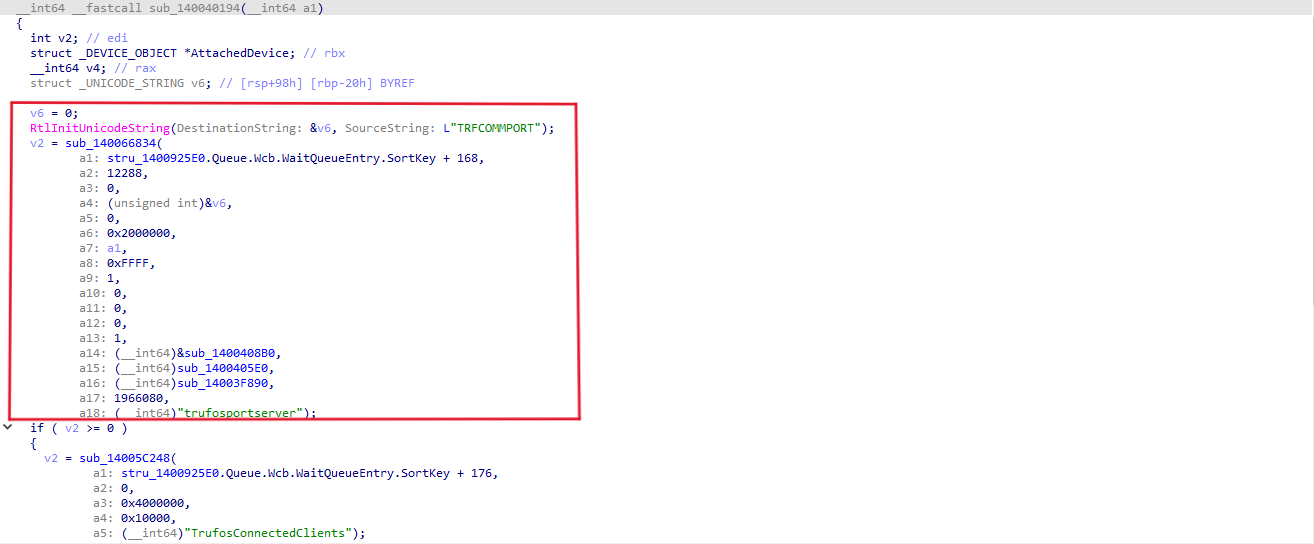
Initialization is orchestrated by sub_140040194, which:
- Builds the object name via
RtlInitUnicodeStringforTRFCOMMPORT. - Fills a
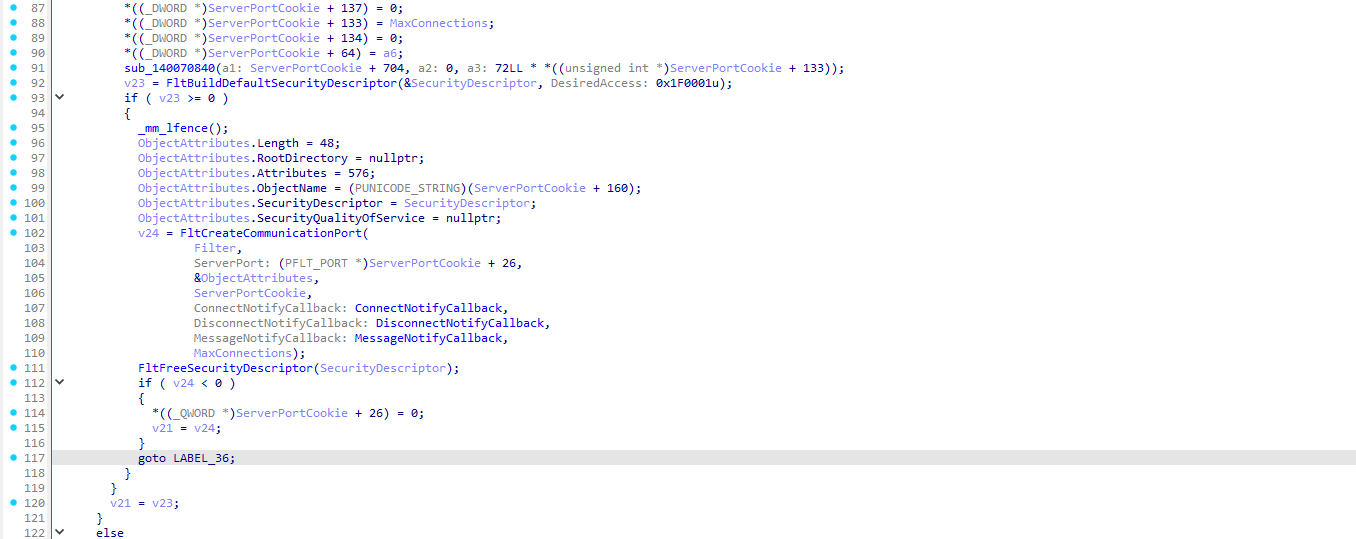
petrulibport-request structure (name, security, callbacks,MaxConnections = 1). - Calls the port factory
sub_140066834→sub_140066BEC→ the actualFltCreateCommunicationPortwrapper, whose source code lives inC:\trufos\petrulib\ptport.candptportflt.c.
The petrulib layer allocates the port/connection object, initializes a connected-client list (LstAllocAndInit / LstInsertHead), and frees it on failure — all logged against ptport.c / ptportflt.c.
4.2 Connection access control and the version handshake
The port is not an open door:
- Security descriptor. The port is created with
FltBuildDefaultSecurityDescriptor(0x1F0001), the Filter Manager default descriptor, which grants access only to SYSTEM and the local Administrators group. - Maximum connections.
MaxConnectionsis limited (each port context allocates a small multi-connection table, capped at0x10). - Version handshake (
sub_1400405E0). A connecting client must supply a 16-byte context whose first three DWORDs are{2, 7, 2}— a version triple (major 2, minor 7, build 2). Clients that fail the handshake are rejected. - Client identity capture. On a valid connect the driver captures
PsGetCurrentProcessId()and a seed value read fromKUSER_SHARED_DATA+0x14(a system-time field used as an anti-replay / uniqueness seed) and passes both tosub_14003F354, which allocates and links a per-connection client object intoTrufosConnectedClients.
So the driver authenticates not by the object’s access check alone, but by who proves the version — a defense-in-depth gate on an SYSTEM/admin-only port.
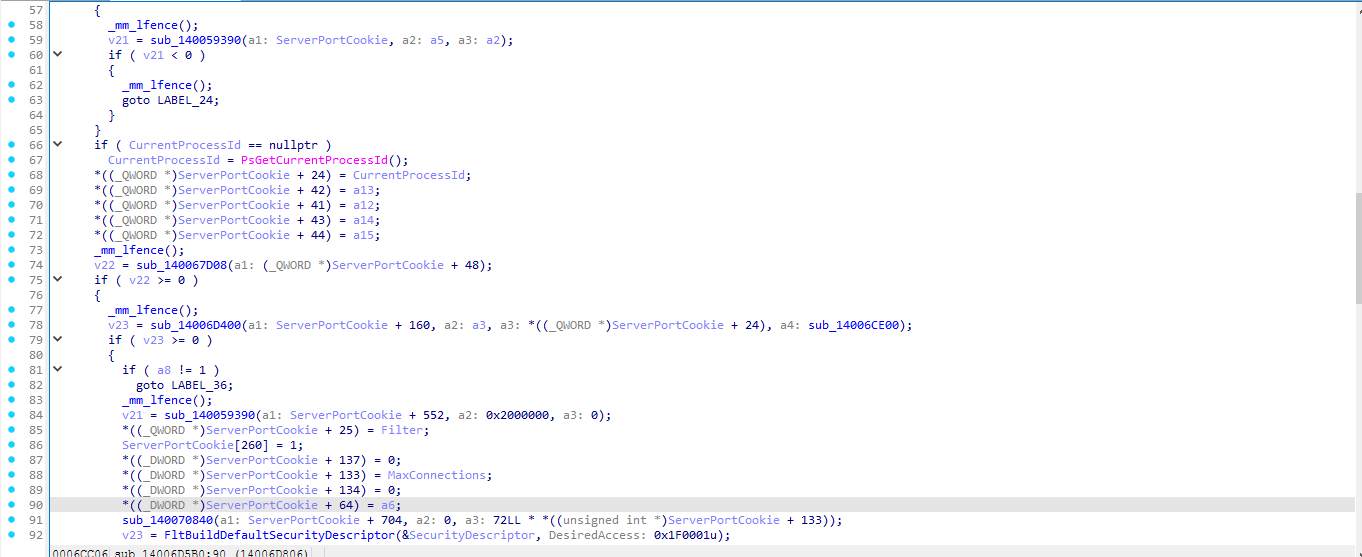
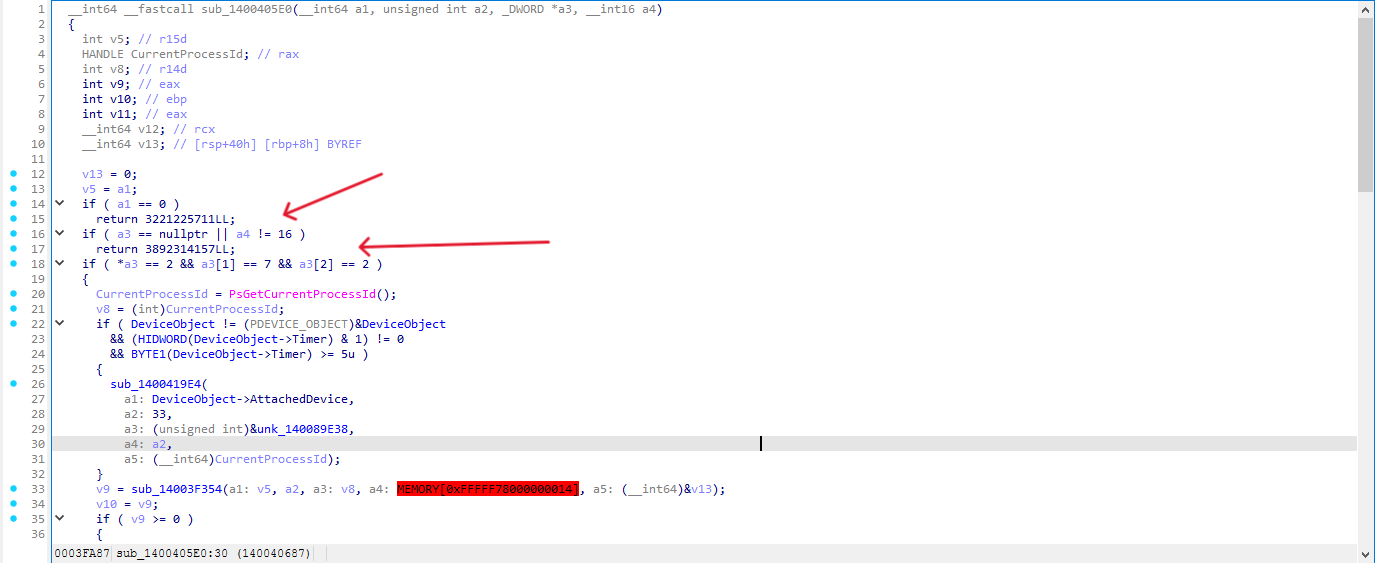
4.3 The message dispatcher and the 27-command surface
sub_1400408B0 is the message-notify root. It is a value switch on the first DWORD of the message and routes to 27 command handlers. The registry of that dispatch is in Appendix E.
Each handler shares a common signature:
1
status = handler(InputBuffer, InputLength, OutputBuffer, OutputLength, ReturnLength)
- Validates
InputBuffer/LengthandOutputBuffer/Lengthup front. - A small fixed set of outputs (e.g.
*ReturnLength = 8or12) is written back on success. - Failures are recorded through an internal trace channel, then a fixed status is returned.
Three handlers account for most of the interesting behavior and are studied in depth below: 4 (image validation), 12 (registry blocking), and 16 (raw directory counting). Handler 22 runs a token-handle duplication worker. The remaining handlers form the broader protection / configuration surface.
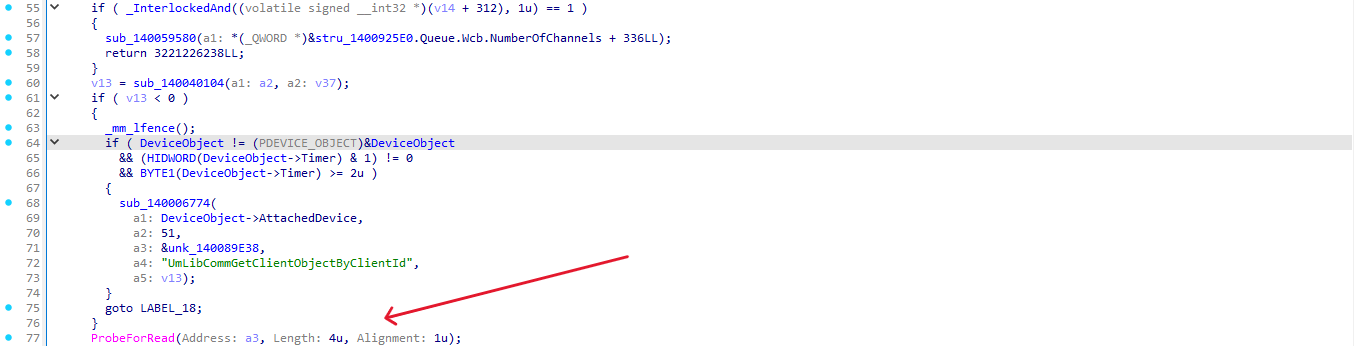
5. Subsystem driver: image validation (TrfBlockImage, command 4)
Handler: sub_14000899C — TrfBlockImage
This is the image-open validation path: it lets user mode request a verdict on a given image before the caller trusts it.
Input contract: a1 (input) ≥ 0x20 bytes, a4 (output) ≥ 8; the input carries an open handle to an image file at a1+8 and further parameters later in the buffer.
- Resolve the real file object.
ObReferenceObjectByHandle(*(HANDLE*)(a1+8), 0, IoFileObjectType)obtains the file object, thenTrfGetRealFileObject(sub_140032864) retrieves the realFILE_OBJECTbeneath any filter/file object, using the Win8+ path when the OS version permits (themajor==6 && minor>=2branch). - Build identity.
sub_140032830derives a path/context,sub_140009084builds a data list, andsub_140007AFClooks up the object;sub_14005C6A0joins it into a per-path structure. - Serialize with a lock.
sub_140058D04(aLockAcquire) guards the global state. - Pick a worker slot. The code scans a fixed 100-entry array of 40-byte slots (
DeviceObjectExtension), zero-initializes a free slot, and copies its input identity into it. - Spawn a worker thread.
PsCreateSystemThread(..., StartRoutine: sub_140009120)launches an asynchronous decision thread that owns the slot; a global counter is incremented (interlocked).
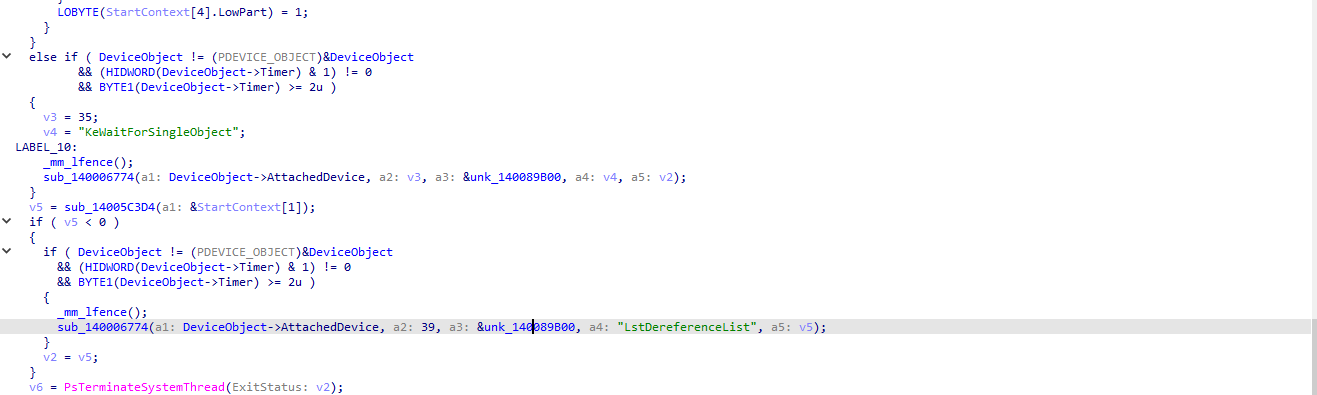
Worker sub_140009120 (the decision thread):
KeWaitForSingleObjecton a global synchronization object with a bounded timeout carried in the slot.- On wait (timeout):
LstWalk(sub_14005C928) over the pending-item list, calling the per-item callbacksub_1400088D0. - Per-item callback
sub_1400088D0: matches a key atentry+40against the worker input; on match it destroys/frees the list entry (sub_140007D60), sets the done flag on the output (*a4 |= 3), and returns the LstWalk “consume and stop” sentinel (0x68000037). - Finish:
LstDereferenceList,PsTerminateSystemThread.
Meaning. Image validation in this driver is asynchronous and timeout-bounded. User mode presents an image; the driver resolves it, attaches an identity, and defers the allow/block to a worker that waits a bounded window and then walks a pending list. The intent is to validate while keeping the caller’s I/O responsive — a common pattern for on-access image trust checks.
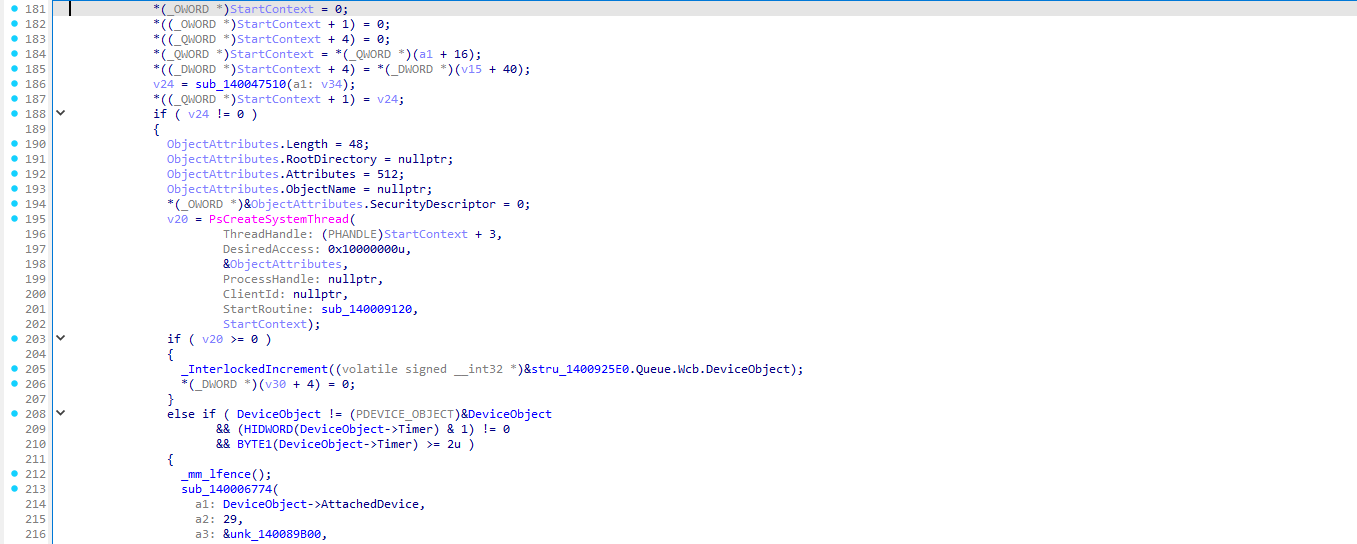

6. Subsystem driver: registry blocking (regblock, command 12)
Handler: sub_140032CF4
This is the registry tamper blocker: user-mode can register a rule that denies write operations to a chosen registry path.
Input contract: InputLength >= 0x20. Two WORD lengths at offsets 26 and 28 declare two data regions, with the invariant SizeOfData1 + SizeOfData2 + 32 == InputLength. Data1 at +30, Data2 at +30+SizeOfData1. A mode DWORD at +4 (values 1..6) selects the operation variant; data is copied as UNICODE_STRING-style buffers.
Registering:
- Copies Data1 →
UNICODE_STRINGbuffer, Data2 → another (ifSize2 != 0), both allocated with the pool tag0x4843573A. - Allocates a 0x50-byte rule context (tag
0x4B52543A), zeroed, and records:- the mode (
ctx+72); a1+24/a1+25flag bytes intoctx+64andctx+65;- a rule ID fetched from the global interlocked counter
dword_140092150.
- the mode (
- Stores the two data strings via
UstrAllocAndInitBufferFromUstr(sub_14005A790). - Optional scoping: if
ctx+65 == 1, resolves a target viaPsLookupProcessByProcessId(a1+16)and stores the EPROCESS; ifctx+64 == 1, resolves a target thread viaPsLookupThreadByThreadId(a1+8)and stores ETHREAD. - Callback registration (one-time). On first use a latch is set and
TrfRegBlockRegisterCallbacks(sub_140033A30) is invoked to install the enforcement hook (below). - The rule is inserted into the global rule list (via
LstInsertHead), and the rule ID is written back to the caller.
Enforcement (sub_140033A30)
1
2
RtlInitUnicodeString(&Altitude, L"320770");
CmRegisterCallbackEx(Function, Alt & 320770, Driver, Context=NULL, Cookie=&global, Reserved=NULL);
This registers a Configuration Manager (registry) callback at altitude 320770. That callback is a single global function that the Filter Manager invokes before/after targeted registry operations; it consults the user-registered rule list and vetoes writes that match an active rule (optionally scoped to a specific process or thread).
The result is a filtered registry protection surface: add a rule on a path, and all configuration callbacks matching it are denied — with optional per-process / per-thread scoping.
7. Subsystem driver: raw-NTFS directory scanning (rawdircnt, command 16)
Handler: sub_140029FA8
This subsystem is the raw directory counter — it enumerates/correlates directory contents at the NTFS metadata level, independent of ordinary file-system APIs.
Input contract: InputLength >= 0x10. DWORD lengths at offsets 4 and 6, both ≥ 0x64 (100), with the invariant Size1 + Size2 + 16 == InputLength. Data1 at +16 (next data at +16+2*(Size1/2)).
Flow:
- Copy Data1 and Data2 into two pooled buffers (each
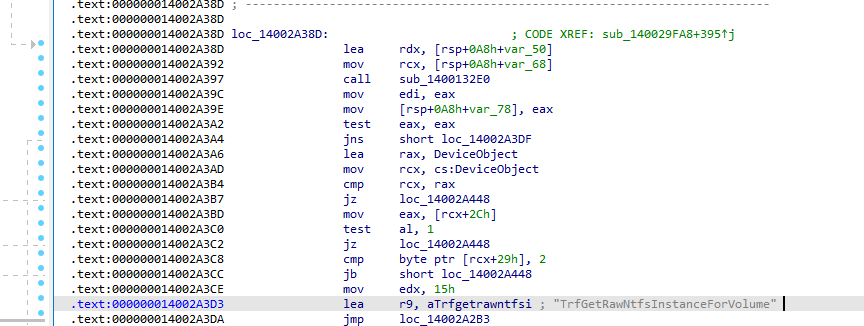
len+2, NULL-terminated) with the0x4843573Atag, and normalize them as UNICODE strings. TrfSplitGuidPath(sub_140014488) — split a GUID/device path (e.g.\??\Volume{GUID}\) for each buffer into structured components.- Resolve the volume for each side:
TrfGetRawNtfsInstanceForVolume(sub_1400132E0) — obtain the raw NTFS minifilter instance for that volume. - Check the two split paths correlate via
sub_14005AD80(expects a fixed sentinel status). RnTransferAttribute(sub_140047E48) — transfer/read an attribute between the two instances (a count / state quantity).- Report the result back in the output buffer.
Why this matters: by reading entries via the raw NTFS instance rather than standard directories, the driver can observe directory-state churn (mass create/delete / enumeration) as raw file-system signal — a view that is hard for user-mode subprocesses to hide and that feeds the behavioral/ransomware-detection story. This is a classic kernel-side on-disk counting technique.
8. Subsystem: token-handle operations (command 22)
Handler: sub_140017DC8 → coordinator sub_140017B00 → worker sub_1400176E0
This command manages a background job that duplicates an impersonation token into a target process — a handle-handoff capability.
Coordinator (sub_140017B00): serialized by a Mutex, it maintains a singleton job flag (byte_1400920E8), a saved input (qword_1400920F0), and a saved output (qword_1400920F8, dword_140092100, dword_140092104). In start mode (arg==1) it:
- if the job is already running, returns the saved output and
STATUS_IMAGE_ALREADY_LOADED; - otherwise initializes an event, spawns the worker
sub_1400176E0, waits for its completion event, and records the thread reference.
In stop mode it signals the worker’s stop event, waits, and releases the reference. This is a run-once / stop-on-command lifecycle.
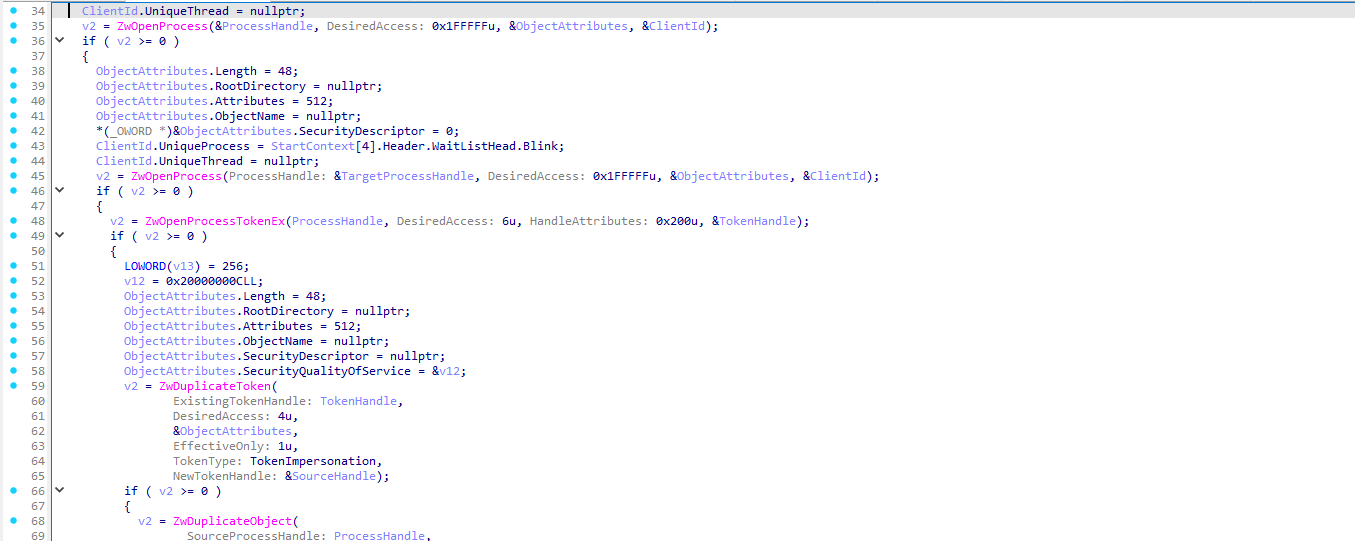
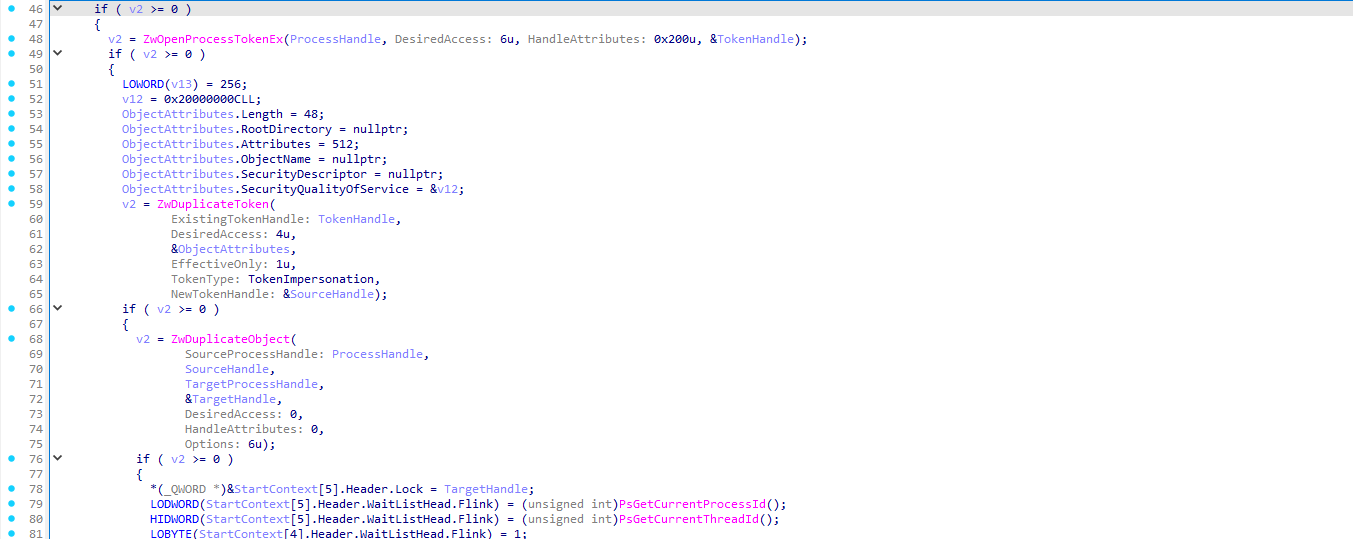
Worker (sub_1400176E0):
- Open the current process (
ZwOpenProcessonPsGetCurrentProcessId). - Open the target process (the job’s target PID).
ZwOpenProcessTokenExthenZwDuplicateToken(ExistingTokenHandle, ..., TokenImpersonation)— produce a duplicate impersonation token of the current process.ZwDuplicateObject— transfer that token handle into the target process and record the resulting target handle, plus current PID/TID and a success flag into the job slot.- Close its local handles; the worker parks on the stop event until the coordinator signals done.
What it does: the driver duplicates a token-handle from its own process into user-selected target, i.e. a handle-handoff / impersonation capability used by the product’s background or self-protection paths.
 —
—
9. Self-protection and reliability measures
trufos.sys is hardened by design. Observed measures:
- Safe-mode refusal.
STATUS_DRIVER_BLOCKEDwhen Safe Mode is detected; prevention of untrusted boot scenarios. - Access-gated IPC. The port allows SYSTEM/Administrators only (default Filter Manager descriptor) and requires the
{2,7,2}handshake — limiting who can reach the command surface. - Dynamic resolution. Calls are resolved at runtime instead of static imports where possible, reducing the attack surface and resilience to static import patching.
- Tamper-interested registry surfacing.
CmRegisterCallbackat altitude320770installs an enforcement hook that vetoes matching registry writes consistently. - State machines and boundary replies. The BDM enablement state machine plus per-feature latches (e.g. the one-time callback install) keep operations from running before they are explicitly enabled.
- Abstraction to async workers. Heavy operations (image validation, token handling) run on separate system threads with explicit events/mutexes and bounded timeouts, avoiding privileged stalls and aligning to IRQL constraints.
- Configure-based placement. Driver registers lock pairs (
UnlockLock,RegistryBlockLock), pool-tag discipline, andlfence-preceded release guards. - Anti-replay/anti-spoof context. The connect path binds a running timestamp-seeded value (
KUSER_SHARED_DATA+0x14) to the client object, complicating spoofing/replay of a connection. - Rigorous validation. Every handler enforces
InputLength/OutputLengthbudgets and returns explicit NTSTATUS error codes (e.g.0xC0000001,0xC00000EF,0xC00000F0,0xC00000F1) on malformed or oversized requests rather than proceeding.
10. Synthesis
Put together, trufos.sys is a reactive real-time protection driver with:
- a single SYSTEM/admin-gated Filter port (
\TRFCOMMPORT, version-gated), - a 27-command dispatcher covering image validation, registry tamper-blocking, raw-NTFS scanning, token/handle operations, and configuration,
- worker-thread architecture for the heavy paths,
- CM-callback registry protection (altitude 320770),
- a BDM state machine plus registry-driven configuration and post-reboot lists,
- and defense-in-depth (safe-mode block, dynamic resolution, descriptors, handshake, per-feature latches).
It complements atc.sys rather than duplicating it: trufos provides the lower-level protection primitives and kernel-side coordination; atc provides the behavioral scoring layer above.
11. Open questions and next steps
Static analysis has limits, stated plainly:
- Exact registry paths. The driver reads its policy from the registry (
drvinit.c) but the specific value names/keys were not all instrumented; a live listing would name them. - The
{2,7,2}handshaker client. Who is the expected peer that connects with that version (a Bitdefender service hostingumlibcomm)? Confirm dynamically. - The remaining 20 handlers. Commands 4, 12, 16, 22 are traced; the rest are mapped by address (Appendix E) but their detailed args/semantics are not yet documented.
- What the
Rn*attribute transfer stores. The exact attribute being relocated between raw-NTFS instances remains unresolved statically. - Altitude interaction. The
320770CM altitude versus other registered filters/callbacks on a live system.
Appendix A — Key global symbols
| Symbol | Role |
|---|---|
stru_1400925E0 | Primary driver state/context container |
DeviceObject | The driver’s device object (global, switched by init) |
byte_1400920E8 | Token-worker job “running” flag |
qword_1400920F8 / dword_140092100 / dword_140092104 | Token-job output values |
dword_140092150 | Atomic registry rule-ID counter |
qword_140092108 | Token worker thread object reference |
TrufosConnectedClients (list) | Connected client-object list |
dword_1400920F0 | Saved token-job input |
PFLT_PORT @ +0xB0 | Stored Filter port handle |
TRFCOMMPORT | Port object name |
Appendix B — Observed strings (raw evidence)
Port/IPC: TRFCOMMPORT, trufosportserver, TrufosConnectedClients
Library/registry shell: UmLibCommAllocAndInitClientObject, UmLibCommDereferenceClient, CmRegisterCallback, altitude string 320770, CmRegisterCallbackEx
List/alloc scaffolding: LstAllocAndInit, LstInsertHead, LstDereferenceList, UstrAllocAndInitBufferFromUstr
Runtime helpers (observed in trace helpers): LockAcquire, LockRelease, KeWaitForSingleObject, KeReleaseMutex, PsCreateSystemThread, PsTerminateSystemThread, ZwOpenProcess, ZwOpenProcessTokenEx, ZwDuplicateToken, ZwDuplicateObject, ObReferenceObjectByHandle
Feature names: TrfBlockImage, TrfGetRealFileObject, TrfSplitGuidPath, TrfGetRawNtfsInstanceForVolume, RnTransferAttribute, TrfRegBlockRegisterCallbacks
State/lifecycle: BdmInitData, BdmEvaluateState, BdmSetAndSaveState, AfterRebootResultsComandList, AfterRebootComandsList
Pool/content tags: 'TRF:' (0x7D0 context), 0x4843573A (string buffers), 0x4B52543A (registry rule context), 0x5254533A (raw-dir instance), 0x46545250 (petrulib filter object), 'PRF:' (prfmiddle)
Appendix C — Observed source paths (raw evidence)
C:\trufos\trufos\regblock.cC:\trufos\trufos\rawdircnt.cC:\trufos\trufos\umlibcomm.cC:\trufos\trufos\umlibcommands.cC:\trufos\trufos\drvinit.cC:\trufos\trufos\context.cC:\trufos\trufos\prfmiddle.cC:\trufos\petrulib\ptport.cC:\trufos\petrulib\ptportflt.c
Appendix D — Key imports / semantics
- Filter Manager:
FltCreateCommunicationPort,FltBuildDefaultSecurityDescriptor,FltFreeSecurityDescriptor,FltCloseCommunicationPort - Configuration Manager:
CmRegisterCallbackEx - NT / process:
ZwOpenProcess,ZwOpenProcessTokenEx,ZwDuplicateToken,ZwDuplicateObject,ZwClose,ObReferenceObjectByHandle,ObfDereferenceObject - Kernel:
PsCreateSystemThread,PsTerminateSystemThread,PsGetCurrentProcessId,PsGetCurrentThreadId,PsLookupProcessByProcessId,PsLookupThreadByThreadId,KeWaitForSingleObject,KeInitializeEvent,KeSetEvent,RtlInitUnicodeString,ExAllocatePoolWithTag,ExFreePoolWithTag,memset
Appendix E — Command dispatch table (27 entries)
| Index | Handler |
|---|---|
| 0 | sub_1400260E8 (→ sub_1400278A8) |
| 1 | sub_140025C8C (→ sub_140026638) |
| 2 | sub_140041C4C |
| 3 | sub_140041A5C |
| 4 | sub_14000899C — TrfBlockImage (image validation) |
| 5 | sub_140015054 (→ sub_140015600) |
| 6 | sub_140015178 |
| 7 | sub_1400127EC |
| 9 | sub_140042304 |
| 11 | sub_14002B40C |
| 12 | sub_140032CF4 — regblock (registry blocking) |
| 13 | sub_140033490 |
| 14 | sub_14001B524 |
| 15 | sub_14001B280 |
| 16 | sub_140029FA8 — rawdircnt (raw-NTFS dir scan) |
| 18 | sub_140017F0C |
| 19 | sub_14002D3BC / 02D0A0 / 02D730 |
| 20 | sub_14002D730 |
| 21 | sub_14002DB54 |
| 22 | sub_140017DC8 → 17B00 → 176E0 (token-handle op) |
| 23 | sub_14002A924 |
| 24 | sub_140029CC4 |
| 25 | sub_14002AC50 |
| 26 | sub_14002A5F8 |
| 27 | sub_14002B8C8 |
| 28 | sub_14002B0E0 |
| 29 | sub_14000B718 |
| 30 | sub_140018C88 |
Appendix F — Glossary
- Minifilter — kernel driver that plugs into the Filter Manager’s I/O pipeline.
- Altitude — the ordered position of a driver/callback in a stack.
- CM callback — Configuration Manager (registry) pre/post notification callback.
- Raw NTFS instance — a direct file-system instance handle to read on-disk state directly.
- IPC port — Filter Manager communication channel between a driver and user-mode processes.
- PPL — Protected Process Light; OS process-protection scheme.
- KUSER_SHARED_DATA — the kernel/user shared page holding low-level system state.